Choosing a security camera system used to be simple. Now, with AI features, full-color night vision, and smart apps, it can get overwhelming.
If you are looking for a security camera, you have likely narrowed it down to the “Big Three”: Hikvision, Dahua, and CP Plus. Together, they dominate the market, especially in India and Asia.
This guide breaks down the technical jargon into plain English to help you decide which brand fits your home, business, or government project.
If you don’t have time to read everything about CCTV Brand Comparison, here is the bottom line:
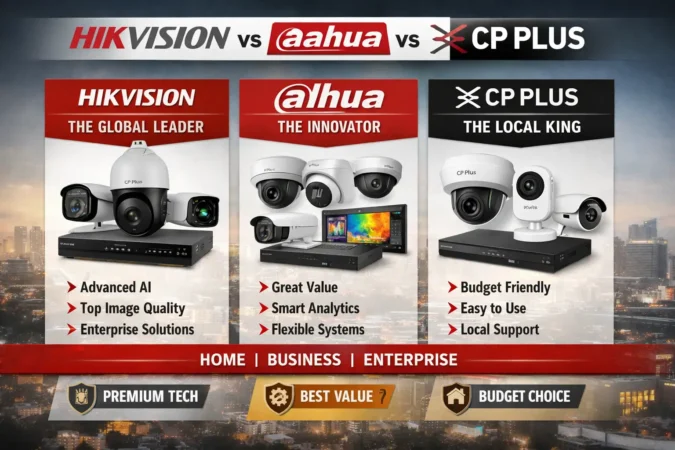
- 🏆 Hikvision (The Tech Leader): Best for premium image quality and large commercial projects. If you want the absolute best picture clarity and night vision, pick Hikvision.
- 🥈 Dahua (The Smart Value): Best for installers and small businesses. They offer high-end AI features (like active sirens) at a lower price than Hikvision.
- 🥉 CP Plus (The Home Favorite): Best for budget buyers and homeowners. They are the easiest to use, widely available in local shops, and offer excellent “Make in India” support.
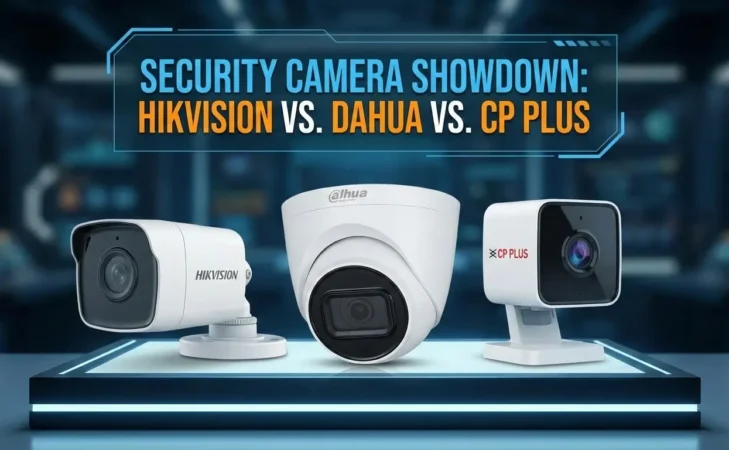
The Brands Explained: Hikvision vs Dahua vs CP Plus
To understand the products, you must first understand the companies behind them. Each brand has a distinct DNA that influences every product they release.
Hikvision: The Global Titan
- Origin: Hangzhou, China (Founded 2001)
- Global Status: World’s largest video surveillance manufacturer.
- The Philosophy: “Technology First.” Hikvision is the Apple of the CCTV world (in terms of dominance, not necessarily design). They have the largest R&D budget in the industry. When you see a new feature become standard—like H.265+ compression or AI-based false alarm reduction—it often starts in Hikvision’s labs.
- The Reputation: They are the benchmark. Installers love them because they “just work.” However, their massive size and Chinese state-backed ownership have led to bans in US government contracts (NDAA non-compliance), though this rarely affects private consumers or businesses in India and Asia.
- Core Strength: Unmatched image processing pipelines. Their cameras often produce the most balanced, noise-free images in difficult lighting.
Dahua Technology: The Aggressive Innovator
- Origin: Hangzhou, China (Founded 2001)
- Global Status: The perpetual runner-up, consistently ranking #2 globally.
- The Philosophy: “Democratizing Tech.” Dahua’s strategy is to take high-end features found in premium Hikvision cameras and bring them to the mid-range market at a lower price point. They are agile and often more willing to experiment with “active” features like flashing lights and sirens.
- The Reputation: The “Installer’s Favorite” for value. Dahua is known for offering better specs-per-dollar than Hikvision. Their open-platform approach makes them very friendly to third-party software developers.
- Core Strength: TiOC (Three-in-One Camera). While Hikvision focuses on “seeing” the crime, Dahua focuses on “stopping” it with active deterrence sirens and strobes built into the camera.
CP Plus: The “Local King” of India
- Origin: Roots in German branding, but effectively an Indian multinational giant today.
- Global Status: Market leader in India; significant presence in the Middle East and Southeast Asia.
- The Philosophy: “Accessibility and Service.” CP Plus realized early on that Indian customers care less about having the absolute newest chipset and more about having a service center nearby. Their marketing (“Upar Wala Sab Dekh Raha Hai”) made CCTV a household concept in India.
- The Reputation: They are the Maruti Suzuki of CCTV. Reliable, affordable, everywhere, and easy to service. While they historically rebadged Dahua and Hikvision OEM hardware, they have aggressively shifted to “Make in India” manufacturing with their own assembly lines in Andhra Pradesh.
- Core Strength: Distribution & Service. No other brand has a deeper penetration in Tier-2 and Tier-3 cities in India. If a CP Plus camera fails in a small town, you can likely find a replacement part locally.
Hikvision vs Dahua vs CP Plus: Feature Comparison
This is where we separate the professional gear from the toys. We will compare them on four critical technical pillars: Low-Light Performance, AI Analytics, Compression, and Build Quality.
A. Low-Light Performance (Night Vision)
Most crimes happen at night. If your camera is blind after 8 PM, it is useless.
- Hikvision (ColorVu): This is the current gold standard. ColorVu cameras use an ultra-large aperture lens (F1.0), which lets in 4x more light than a standard lens. Combined with a high-sensitivity sensor, they stay in full color even in near-pitch darkness without turning on a light. When it gets absolute pitch black, a soft, warm supplemental light turns on. The result is a video that looks like daytime.
- Dahua (Full-Color / Starlight): Dahua’s “Starlight” technology is legendary and was the market leader before ColorVu arrived. It is exceptional at maintaining sharpness in low light. Their newer “Full-Color” line rivals ColorVu, but in side-by-side tests, Hikvision often retains slightly better color accuracy and less “noise” (graininess) in the shadows.
- CP Plus (Indigo / Full Color): CP Plus has “Color” models, but they are often a generation behind the flagship tech of the other two. Their standard IR (Infrared) night vision is solid—black and white, crisp enough for general monitoring. However, their “Full Color” models often rely more heavily on turning on the white LED spotlight rather than having a hyper-sensitive sensor.
Winner: Hikvision. Their image processing (ISP) removes noise better than anyone else.
B. AI & Video Analytics (The “Brain”)
Old cameras recorded everything: blowing leaves, rain, moving shadows. This filled up hard drives and annoyed users with false alerts.
- Hikvision (AcuSense): AcuSense is a deep-learning algorithm embedded in the camera (or NVR). It can classify objects as “Human,” “Vehicle,” or “Other.” It is incredibly accurate (90%+). You can set it to only alert you if a human crosses a line. It filters out cats, rain, and trees effectively.
- Dahua (WizSense / WizMind): Dahua’s AI is arguably just as good, and sometimes more flexible. Their SMD (Smart Motion Detection) 4.0 is fantastic. A unique feature Dahua often does better is “Quick Pick”—allowing you to quickly search through footage for “Human with Blue Shirt.”
- CP Plus (Insta / Project Series): The budget CP Plus cameras (Cosmic series) generally lack advanced AI, relying on basic pixel-based motion detection (which triggers false alarms easily). To get Human Detection, you usually need to step up to their IP camera range or their specific “AI DVRs.” It is available, but it’s not as “standard” across the range as it is with Hikvision/Dahua.
Winner: Tie between Hikvision & Dahua. Hikvision is slightly more accurate; Dahua offers more AI features at a lower price point.
C. Compression Standards (Storage Efficiency)
4K video takes up massive space. Efficient compression saves you money on Hard Disk Drives (HDD).
- Hikvision (H.265+): Hikvision developed a proprietary “Plus” version of the H.265 standard. It aggressively compresses static backgrounds (like a wall that doesn’t move) while keeping the moving subject high quality. This can save 20-30% more space compared to standard H.265.
- Dahua (Smart H.265+): Dahua followed suit with their own smart codec. It is very similar in performance to Hikvision’s implementation.
- CP Plus (H.265): Most CP Plus consumer models use standard H.265. It is efficient, but for large 16-camera setups, you will spend more on hard drives with CP Plus than with Hikvision.
Winner: Hikvision (Marginal lead).
D. Audio Capabilities
- Dahua: This is a strong point for Dahua. Many of their mid-range “eyeball” cameras come with built-in microphones as standard. The audio quality is surprisingly crisp.
- Hikvision: They are catching up (“A” in the model number denotes Audio), but traditionally, you had to pay extra or buy specific models to get audio.
- CP Plus: Their Wi-Fi cameras (EzyKam) have excellent two-way talk. Their analog cameras require external mics in many cases, though “Audio-over-Coax” is becoming common in their Indigo series.
Winner: Dahua.
Security Concerns & Government Bans
- The Issue: Both Hikvision and Dahua are Chinese state-linked companies. They are currently banned from being used in US Federal Government systems (under NDAA regulations) due to data privacy concerns.
- Does this matter to you?
- For a home user: Likely not. As long as you use a strong password, your feed is safe.
- For Government/MNCs: Yes. If you are a US-based company or an Indian government entity with strict data rules, you might prefer CP Plus (which is seen as “safer” in India due to local manufacturing) or fully Western brands like Honeywell or Bosch.
Product Portfolio: From Home to City Surveillance
Category 1: Home Wi-Fi Cameras (Baby/Pet Monitors)
This is the segment most regular consumers care about. Plug-and-play, no wires.
- CP Plus (EzyKam): The absolute market leader in India for this segment. Models like the CP-E24A or CP-Z40A are ubiquitous. They are cheap (often under ₹2,000 / $25), easy to set up, and the server response time in India is fast. However, the app can feel a bit “budget.”
- Hikvision (EZVIZ): EZVIZ is Hikvision’s consumer brand. These cameras (like the C6N or C8C) are significantly more polished. The hardware feels premium, and the app is slicker. They integrate beautifully with Google Home and Alexa.
- Dahua (Imou): Imou is Dahua’s answer. They are stylish and often have better AI tracking than CP Plus. The Imou Ranger 2 is a direct competitor to the EzyKam, often winning on video smoothness.
Verdict: Buy EZVIZ for quality. Buy CP Plus for price and local support.
Category 2: SMB & Retail (Analog/HD-CVI/TVI)
For shops that need 4-8 cameras wired to a DVR.
- CP Plus (Cosmic/Indigo): Dominates this space purely on price and availability. You can walk into any electrical shop and buy a CP Plus kit. It’s reliable enough for “record and forget.”
- Hikvision (TurboHD): If you want 5MP or 4K over analog cables, Hikvision TurboHD is the way to go. Their “ColorVu Turbo” cameras bring full-color night vision to old-school wired setups.
- Dahua (HDCVI): Dahua actually invented the HDCVI standard that allows HD video over coax cables. Their Coax cameras often have better transmission range (up to 800m) than competitors.
Verdict: CP Plus for budget shops. Hikvision if you want high-definition quality over old wires.
Category 3: Enterprise & IP Systems
For factories, offices, and campuses using Network (IP) Cameras.
- Hikvision: The clear winner. Their “DeepinView” and “Pro Series” lines are incredibly powerful. They offer thermal cameras, explosion-proof cameras, and license plate recognition (ANPR) that works flawlessly at high speeds.
- Dahua: A very strong runner-up. Their ANPR and facial recognition are used in major cities globally. They are generally 15-20% cheaper than Hikvision for similar specs.
- CP Plus: They have a “Project Series” for this, but it is often OEM equipment. For critical infrastructure, integrators usually prefer the native R&D of Hikvision or Dahua.
Verdict: Hikvision is the professional choice.
Software Ecosystem: The User Experience
Hardware is only half the battle. If the app crashes when you need to check an alert, the system is useless.
Mobile Apps
- Hik-Connect (Hikvision):
- Pros: Extremely feature-rich. Allows remote playback, sharing devices with family, and deep configuration settings. Fast P2P cloud access.
- Cons: Can be overwhelming for non-techies. Unbinding a device from an old account is a headache (security feature).
- DMSS (Dahua):
- Pros: arguably the best interface. Modern, dark-mode design, very snappy. It loads video streams faster than Hik-Connect in low-bandwidth areas.
- Cons: Notification management can sometimes be tricky to customize.
- gCMOB / CP-Connect (CP Plus):
- Pros: Simple. Big buttons. easy to understand “Live View” and “Playback.”
- Cons: Feels dated. Ads for CP Plus products sometimes appear in the app. Resolution switching (SD to HD) can be laggy.
Desktop VMS (Video Management Software)
- Hikvision iVMS-4200: A beast. It can manage access control, video intercoms, and alarms. But it has a steep learning curve.
- Dahua SmartPSS: The perfect balance. It’s powerful enough for a 64-camera setup but intuitive enough for a security guard to learn in 10 minutes.
- CP Plus KVMS Pro: Functional. It gets the job done for monitoring, but lacks the deep analytics reporting of the others.
6. The “India Factor”: Support and Warranty
This is where CP Plus plays its ace card.
- Service Center Reach: CP Plus has the densest network of service centers in India. In many cases, they offer “burnt warranty” (covering power surge damage), which is a massive issue in India due to voltage fluctuations. Hikvision and Dahua usually void warranty on burnt PCBs.
- Replacement Speed: Because CP Plus manufactures/assembles locally, parts are available. Hikvision and Dahua rely on imports for spares, which can lead to weeks of waiting if a specific board is out of stock at the national distributor.
- Localization: CP Plus voice prompts are often available in Hindi and other regional languages. Their manuals and setup guides are tailored for the Indian context.
Pricing & Total Cost of Ownership (TCO)
Let’s look at the math for a standard 4-Camera Setup (4MP IP System):
- Hikvision:
- Hardware Cost: ~$350 – $450 (₹30,000 – ₹40,000)
- Installation: High (Requires skilled technician for configuration)
- Longevity: 5-7 years
- Dahua:
- Hardware Cost: ~$280 – $350 (₹24,000 – ₹30,000)
- Installation: Medium
- Longevity: 5-7 years
- CP Plus:
- Hardware Cost: ~$200 – $250 (₹16,000 – ₹20,000)
- Installation: Low (Plug and play)
- Longevity: 3-5 years
Analysis: CP Plus is cheaper upfront. However, Hikvision and Dahua cameras tend to outlast them. If you factor in replacing a CP Plus camera after 3 years, the cost evens out. For “fit and forget” budget projects, CP Plus wins. For long-term value, Dahua wins.
Security & Privacy: What You Need to Know
We must address the geopolitical concerns.
- NDAA Compliance: Both Hikvision and Dahua are banned from US Federal government use due to the “National Defense Authorization Act” (NDAA). The concern is potential backdoors for the Chinese government.
- Does this affect you?
- Residential: Practically, no. The risk of a foreign government spying on your front porch is negligible compared to the risk of a hacker guessing your weak password “admin123”.
- Government/Defense (India): Yes. The Indian government has also moved toward “Make in India” mandates (PMA compliance).
- CP Plus Stance: CP Plus positions itself as the “Indian” alternative. While they historically sourced from China, their new manufacturing plants in India allow them to meet many local procurement norms that pure Chinese imports cannot. This makes them a safer bet for Indian government tenders.
Buying Scenarios: What Should You Buy?
Scenario A: The Apartment Owner
- Need: Keep an eye on the maid and the pet dog while at work.
- Recommendation: CP Plus EzyKam (CP-E24A) or EZVIZ C6N.
- Why: You don’t need a DVR or wiring. Just plug it into a socket, connect to Wi-Fi, and you’re done. CP Plus is cheaper; EZVIZ is better quality.
Scenario B: The Retail Store (Jewelry/Mobile Shop)
- Need: High-resolution footage to see cash handling and faces clearly. Active deterrence to scare thieves.
- Recommendation: Dahua TiOC Series.
- Why: The active siren and flashing lights can stop a robbery before it starts. The audio recording is crucial for dispute resolution at the counter.
Scenario C: The Luxury Villa / Farmhouse
- Need: Perimeter protection, night vision for dark gardens, no false alarms from trees/animals.
- Recommendation: Hikvision ColorVu + AcuSense.
- Why: You need the ColorVu to see into the dark corners of the property without installing floodlights. AcuSense ensures you only get woken up if a human jumps the fence, not a cat.
Scenario D: The Warehouse / Factory
- Need: Coverage of large areas, long cable runs, durability against dust and heat.
- Recommendation: Hikvision Pro Series (IP).
- Why: Superior compression (H.265+) saves massive storage costs on 24/7 recording. The cameras are built like tanks (IP67/IK10 ratings).
Comparison Table
| Key Parameter (Very Important) | Hikvision | Dahua Technology | CP Plus |
|---|---|---|---|
| Primary Market Focus | Enterprise, Government, Large Projects | SMBs, Professional Installers | Home users, Small shops, Mass market |
| Global Market Rank | #1 Worldwide | #2 Worldwide | India-focused leader |
| Overall Image Quality | ⭐⭐⭐⭐⭐ (Best-in-class) | ⭐⭐⭐⭐½ (Very close) | ⭐⭐⭐⭐ (Good for price) |
| Low-Light / Night Performance | ColorVu & DarkFighter (Excellent in near-darkness) | Starlight & Full Color (Strong, high value) | IR & Full Color (Good, but weaker in extreme dark) |
| AI Accuracy (Human/Vehicle) | Very High (AcuSense, Deep Learning) | High (WizSense / WizMind) | Basic–Medium (Advanced AI only in Project series) |
| False Alarm Reduction | Excellent | Very Good | Average |
| AI for Large Areas (Warehouses, Campuses) | Excellent | Very Good | Limited |
| Mobile App Experience | Feature-rich but complex (Hik-Connect) | Smooth & modern (DMSS) | Very simple & beginner-friendly (gCMOB / CP-Connect) |
| PC Software | iVMS-4200 (Powerful, steep learning curve) | SmartPSS (Balanced) | KVMS Pro (Basic, easy) |
| Ease of Installation | Medium (needs trained installer) | Easy–Medium | Very Easy (plug-and-play) |
| PoE Network Stability | Excellent | Excellent | Good |
| Firmware Stability | Very Stable (frequent updates) | Stable | Stable but fewer advanced updates |
| Storage Efficiency | H.265+ (Best storage saving) | H.265 | H.265 |
| Product Range Depth | Extremely wide (Thermal, ANPR, Radar, PTZ) | Wide (AI, PTZ, Analytics) | Limited at high-end |
| Wi-Fi / Home Cameras | Available but costly | Limited | Strong & affordable |
| Scalability (4 → 400 Cameras) | Excellent | Very Good | Limited |
| Integration with Access Control / Alarm | Excellent | Very Good | Basic |
| Local Service Support (India) | Distributor dependent | Distributor dependent | Strong local service network |
| Warranty Handling | Standard (process-driven) | Standard | Faster replacements locally |
| Security / Compliance Concerns | Higher scrutiny globally | Similar scrutiny | Lower concern perception |
| Ideal User Type | Enterprises, Airports, Campuses | Installers, SMBs, Tech users | Homes, Shops, Budget users |
| Price Level | $$$ (Premium) | $$ (Best value) | $ (Budget) |
| Total Cost of Ownership (5 yrs) | Medium–High | Medium | Low |
| Best Use Case | Mission-critical security | Professional installations | Simple “fit & forget” setups |
Conclusion: The Final Verdict
There is no single “best” brand, only the best brand for your specific constraints.
- The Purist’s Choice: If you demand the absolute best image quality, superior night vision, and a system that feels “premium,” buy Hikvision. It is the professional standard for a reason.
- The Smart Choice: If you want advanced AI features (like sirens and smart detection) but want to save 20% compared to Hikvision prices, buy Dahua. It is the sweet spot of performance and value.
- The Pragmatic Choice: If you are on a strict budget, live in a smaller Indian town, and value local service over cutting-edge specs, buy CP Plus. It is “good enough” for 90% of home users and comes with peace of mind regarding repairs.
Final Tip: Regardless of the brand, the installer matters more than the camera. A Hikvision camera installed poorly (bad angles, wrong cable, default password) is worse than a CP Plus camera installed perfectly. Choose a reputable installer first, then the brand.
Frequently Asked Questions (FAQ)
Q1: Can I mix and match brands? Can I use a Hikvision camera with a CP Plus DVR?
Yes, but… nearly all modern IP cameras support a protocol called ONVIF. This allows them to talk to each other. However, you will likely lose advanced features (like Motion Detection or AI alerts). You might only get a continuous video stream. It is highly recommended to stick to one brand for both Camera and Recorder (NVR/DVR).
Q2: Which brand is best for hacking security?
All three brands have had vulnerabilities in the past. The most important security step is not the brand, but the user habits:
1. Change the default password.
2. Enable encryption (Hikvision calls it “Stream Encryption”).
3. Do not port forward your NVR directly to the internet; use their P2P cloud apps (Hik-Connect/DMSS) which are more secure.
Q3: Does CP Plus manufacture their own cameras?
Historically, CP Plus was an OEM (Original Equipment Manufacturer) brand, meaning they bought hardware from Dahua/Hikvision and rebranded it. However, in recent years, they have invested heavily in Indian manufacturing facilities (in Tirupati and Noida) and now assemble and manufacture a significant portion of their localized lineup in India.
Q4: What is the difference between DVR and NVR?
DVR (Digital Video Recorder): Uses Coax cables (older tech). Cheaper, but lower quality limit. Good for upgrading old systems.
NVR (Network Video Recorder): Uses Ethernet (CAT6) cables. Digital, higher quality, supports Power over Ethernet (PoE). This is the future and recommended for all new installations.