In today’s digital world, security cameras are everywhere and record almost every major incident. Many people wrongly believe that simply having a video recording on a pen drive is enough to win a legal case.
However, presenting video proof in front of a judge requires you to follow strict legal procedures. You must understand the specific laws of your country to ensure your video is actually accepted by the court.
What Are the Rules for Using CCTV Footage as Evidence?
CCTV footage is highly valid and powerful evidence in court, but only when it follows the proper legal rules. Courts do not just accept any video you bring to them. They carefully check whether the footage is real, legally obtained, and properly handled. If these rules are broken, the judge will reject the video completely.
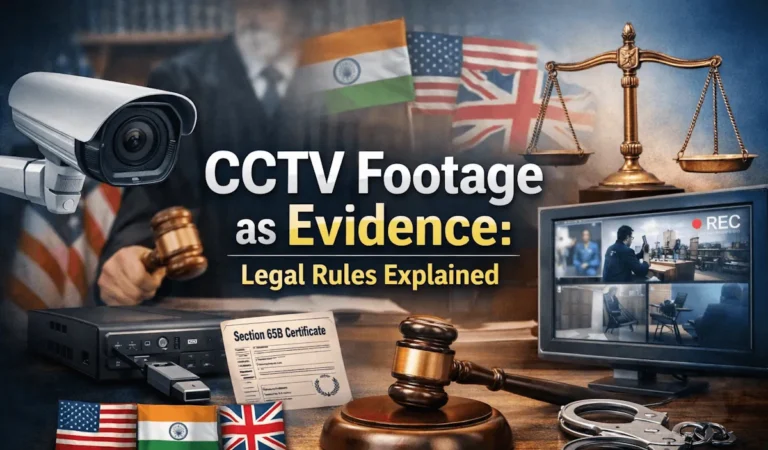
Common Rules for Using CCTV Footage as Evidence (Applicable Worldwide)
No matter which country you are in, these basic rules are followed by almost all legal systems:
1. Footage Must Be Relevant –
The video must directly relate to the crime or the case being discussed. If the footage does not help prove a specific point or fact, the court will simply reject it to save time.
2. Footage Must Be Authentic (Most Important Rule) –
The court must confirm that the video is 100% original. There should be absolutely no editing, cutting, or tampering. Because electronic evidence can be easily changed using software today, courts check the authenticity of the source very strictly.
3. Chain of Custody Must Be Clear
“Chain of Custody” is a record of the video’s journey. The court checks who recorded the video, who downloaded it from the DVR, who handled the pen drive, and how it finally reached the police or the court. If this chain is broken or someone unknown handles the file, the evidence becomes doubtful.
4. Proper Quality Matters
If the footage is too dark, blurry, or faces are not clearly visible, it may not be useful in a case. Clear video is important so that people, actions, and details like number plates can be properly identified.
5. Footage Must Be Legally Recorded
Footage must be recorded in a lawful way. Recording in private areas like bathrooms or changing rooms is illegal and can lead to rejection of the evidence. Cameras should be installed only in permitted areas and used for valid security purposes.
🇮🇳 Rules for Using CCTV Footage as Evidence in India (Latest 2024–2026 Law)
India has very strict and clear legal rules for submitting CCTV evidence.
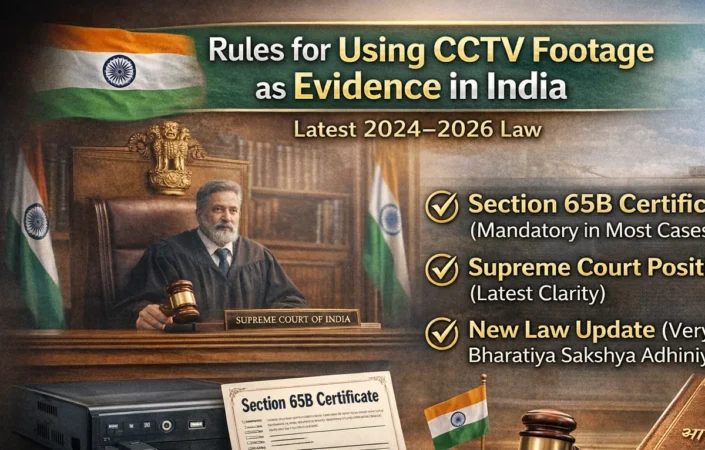
1. Section 65B Certificate (Mandatory in Most Cases)
If you are submitting CCTV footage to an Indian court on a CD or pen drive, it must include a Section 65B certificate. This is a signed document confirming how the video was recorded, the details of the DVR/NVR, and a promise that the video is not tampered with. Without this certificate, the footage is generally not admissible in court.
2. Supreme Court Position (Latest Clarity)
The Supreme Court of India has clearly stated that the video along with the 65B certificate is valid evidence on its own. There is no need to provide a written transcript of the video for it to be accepted.
3. New Law Update (Very Important)
The old Indian Evidence Act was replaced in 2024 by the Bharatiya Sakshya Adhiniyam (BSA). Under this new law, electronic records are fully recognized, and CCTV footage is treated exactly like a physical paper document.
4. Exception (Latest 2026 Update)
In some specific cases, especially in family courts, the judge may accept the CCTV video even without the strict 65B certificate, provided the judge is fully satisfied that the video is authentic and the source is genuine.
5. Authenticity Still Required
Even if you submit the 65B certificate, the court will still cross-check everything. The judge will want to be fully sure that the DVR or NVR was working properly and that nobody has manipulated or edited the video file. Just having the certificate is not enough; the original recording device must be kept secure from unauthorized access to prove that the footage is 100% genuine.
🇺🇸 Rules for CCTV Evidence in the USA
In the USA, the Rules for Using CCTV Footage as Evidence are governed by the Federal Rules of Evidence along with various state privacy laws, ensuring proper use and legal compliance.
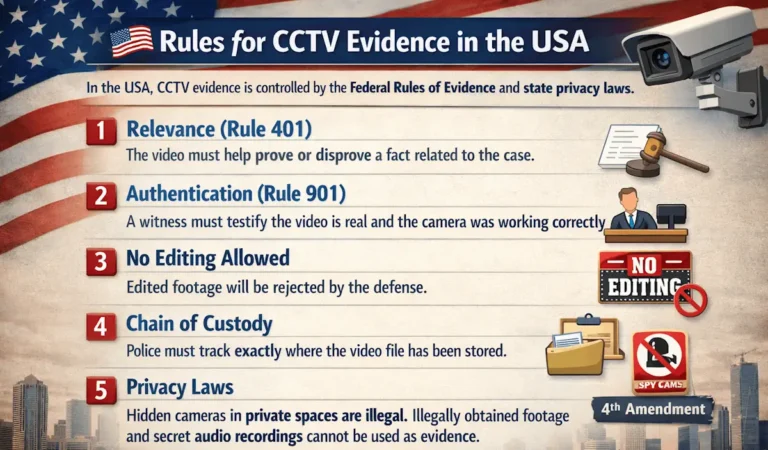
1. Relevance (Rule 401)
Just like the global rule, the video must help prove or disprove a fact related to the case.
2. Authentication (Rule 901)
Someone must stand in court and confirm the video is real. A witness (like the shop owner) must swear that the camera was working correctly on that day and that the video accurately shows what happened.
3. No Editing Allowed
Any footage that looks cut, spliced, or edited will likely be rejected by the defense lawyers immediately.
4. Chain of Custody
This is extremely important in US criminal cases. The police must keep a strict log of exactly where the video file has been stored from the moment it was copied.
5. Privacy Laws
The US has strong privacy laws under the Fourth Amendment. Hidden cameras in private spaces are illegal, and any footage obtained illegally cannot be used as evidence. Also, recording audio without permission is a serious crime in many US states.
🇬🇧 Rules for CCTV Evidence in the UK
The UK has strict laws that focus on protecting citizen privacy and personal data in all CCTV use. These rules apply both in general surveillance and when using CCTV Footage as Evidence, ensuring lawful and fair handling at every stage.
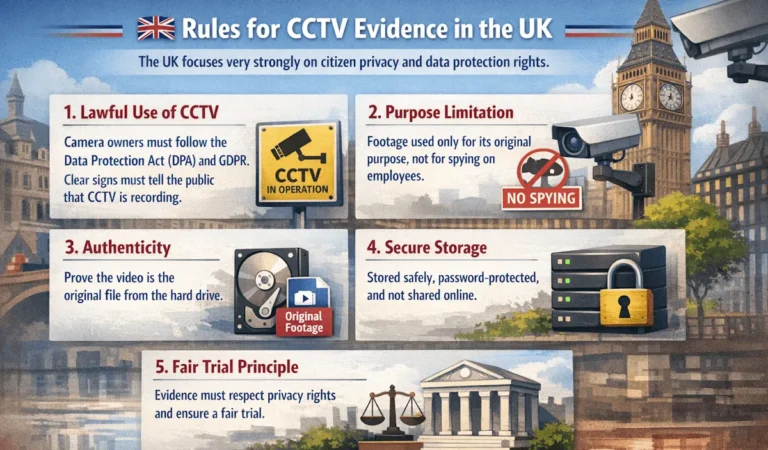
1. Lawful Use of CCTV
Camera owners must follow the Data Protection Act (DPA) and GDPR. This usually means putting up clear signs telling the public that CCTV is recording.
2. Purpose Limitation
The footage should only be used for the exact purpose it was installed for, such as security or legal investigations. You cannot use security cameras just to spy on your employees’ daily habits.
3. Authenticity
Just like India and the USA, you must prove the video is the original file from the hard drive.
4. Secure Storage
CCTV footage must be stored safely, password-protected, and not misused or shared on social media. If it is leaked, it might ruin the court case.
5. Fair Trial Principle
The evidence must be presented in a way that does not violate a person’s privacy rights unnecessarily, ensuring a fair trial for everyone involved.
Summary of Country-Wise Rules
| Rule | India | USA | UK |
| Certificate Required | ✅ Yes (65B/BSA) | ❌ No | ❌ No |
| Authentication | ✅ Strict | ✅ Strict | ✅ Strict |
| Privacy Law | IN-Privacy Law – Moderate | US-Privacy Law Strong | UK-Privacy Law Very Strong |
| Chain of Custody | Important | Very Important | Important |
Common Mistakes (Why CCTV Gets Rejected)
Many people lose their cases due to simple mistakes in handling video evidence. Courts may reject your footage if the below mentioned Rules for CCTV Evidence are not followed carefully:
- ❌ No 65B certificate is provided (in India).
- ❌ The video is edited, cut, or paused to hide something.
- ❌ The footage is of very poor quality and nothing is visible.
- ❌ The source is unknown, meaning nobody knows which camera recorded it.
- ❌ Illegal camera placement, such as spying in a private room.
To avoid hardware failures that lead to lost or poor-quality videos just when you need them for court, make sure you regularly service your system using proper CCTV maintenance tools.
Practical Tips for CCTV Users
If an incident happens and you need to give footage to the police or court, follow these steps:
- Keep the Original Safe: Do not delete the video from your DVR/NVR until the case is completely closed.(Check-How Long Do CCTV Cameras Keep Footage?)
- Take a Proper Backup: Export the video carefully to a clean, virus-free pen drive or CD.
- Check Date & Time: Ensure your DVR’s date and time are set correctly. Wrong timestamps can ruin your evidence.
- Do Not Share Online: Never post evidence footage on WhatsApp or Facebook before the court case is over.
Final Conclusion
CCTV footage is powerful evidence, but only when legal Rules for CCTV Evidence are followed.
- In India, the Section 65B certificate (under the new BSA law) is the key.
- In the USA, proving authenticity and relevance is the most important step.
- In the UK, respecting privacy and lawful use is strictly monitored.
If your CCTV system is properly installed, maintained, and the footage is handled legally, your video can strongly support your case and help deliver justice in court.